
Why Are Gold Prices Rising in 2026? 7 Key Reasons
Why Are Gold Prices Rising in 2026? 7 Key Reasons Investors Need to Know
Gold has once again become one of the world’s most closely watched assets.
Throughout 2026, the precious metal has attracted strong investor demand as economic uncertainty, geopolitical tensions, and changing monetary policy continue to influence global financial markets.
But why are gold prices rising in 2026?
The answer involves several powerful forces working together rather than a single event.
Let’s examine the seven biggest reasons driving gold higher.
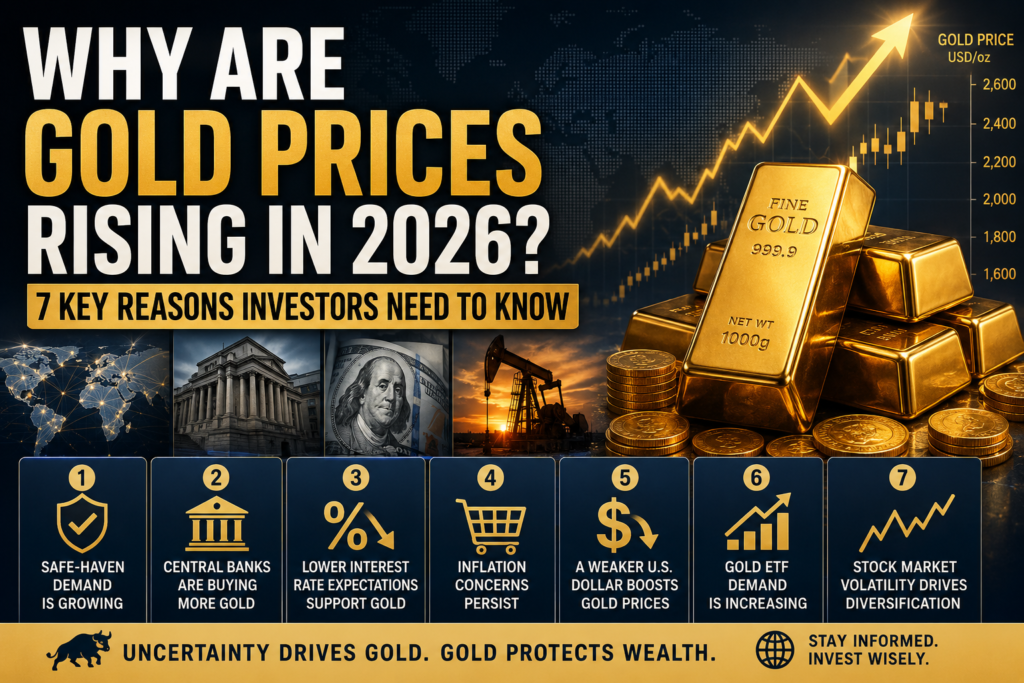
1. Investors Are Seeking Safe-Haven Assets
Whenever uncertainty increases, investors typically move toward assets considered safer than stocks.
Gold has historically served as one of the world’s primary safe-haven investments.
Growing geopolitical risks, military conflicts, and global economic uncertainty have encouraged investors to reduce risk exposure and increase allocations to gold.
2. Central Banks Continue Buying Gold
Central banks around the world have steadily increased their gold reserves over the past several years.
Many countries are seeking to diversify away from excessive dependence on the U.S. dollar while strengthening long-term reserve assets.
Strong official-sector demand reduces available supply and supports higher gold prices.
3. Expectations for Lower Interest Rates
Gold does not generate interest or dividends.
However, when investors expect central banks to lower interest rates, the opportunity cost of holding gold decreases.
As expectations grow for future monetary easing, gold often becomes more attractive relative to bonds and cash.
4. Inflation Concerns Remain
Although inflation has moderated compared with previous years, investors remain cautious.
Higher energy prices, wage growth, and supply-chain risks could keep inflation above central-bank targets.
Gold has long been viewed as one of the most popular inflation hedges.
5. A Weaker U.S. Dollar Supports Gold
Gold is priced globally in U.S. dollars.
When the dollar weakens, gold generally becomes cheaper for international buyers.
This often increases global demand and supports higher prices.
6. ETF Demand Is Increasing
Gold ETFs continue attracting investors who want exposure to gold without purchasing physical bullion.
Institutional investors frequently use ETFs to hedge market volatility.
Growing ETF inflows usually create additional buying pressure.
Popular examples include:
- SPDR Gold Shares (GLD)
- iShares Gold Trust (IAU)
7. Stock Market Volatility
After strong gains in technology and AI stocks, many investors are rebalancing portfolios.
Rather than concentrating entirely in equities, investors often increase allocations to defensive assets.
Gold has become one of the preferred diversification tools during periods of elevated volatility.
Will Gold Continue Rising?
No one can predict future prices with certainty.
However, several factors remain supportive:
- Central-bank purchases
- Geopolitical uncertainty
- Inflation risks
- Potential interest-rate cuts
- Strong ETF demand
On the other hand, gold could face pressure if:
- Inflation falls rapidly
- Interest rates stay higher for longer
- The U.S. dollar strengthens
- Global economic confidence improves
Should Investors Buy Gold?
Gold should not be viewed as a guaranteed source of returns.
Instead, many investors use gold as:
- A portfolio diversifier
- An inflation hedge
- A safe-haven asset during market stress
Holding a balanced portfolio rather than concentrating entirely in one asset class remains an important investment principle.
Final Thoughts
Gold prices are rising in 2026 because multiple global forces are supporting demand simultaneously.
Safe-haven buying, central-bank purchases, inflation concerns, interest-rate expectations, ETF inflows, and stock-market volatility have all contributed to gold’s strength.
While future price movements remain uncertain, gold continues to play an important role for investors seeking diversification during periods of economic uncertainty.
This article is for informational purposes only and does not constitute financial or investment advice.
Key Takeaways
- Gold benefits from safe-haven demand.
- Central banks continue accumulating gold.
- Lower interest-rate expectations support prices.
- Inflation remains an important driver.
- ETF inflows are increasing.
- Stock-market volatility encourages diversification.
- Gold remains a long-term portfolio hedge.