
Why Is the U.S. Stock Market Falling Today? Key Reasons Investors Should Know
Why Is the U.S. Stock Market Falling Today? Key Reasons Investors Should Know
The U.S. stock market has come under renewed selling pressure, with technology and semiconductor stocks leading the decline.

In the latest trading session on July 17, 2026, the S&P 500 fell approximately 1%, while the Nasdaq Composite declined about 1.4%. The Dow Jones Industrial Average also finished lower as weakness in artificial intelligence and semiconductor stocks spread across the broader market.
Investors are now asking an important question: Why is the U.S. stock market falling today?
The answer is not based on one event. Instead, several concerns are affecting investor sentiment at the same time.
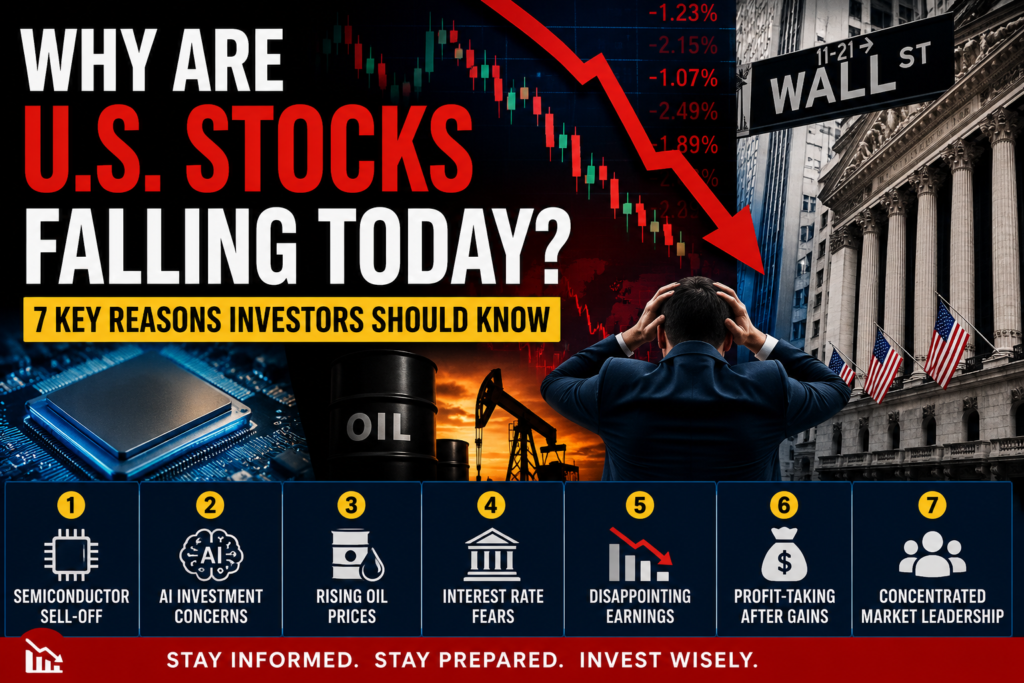
1. Semiconductor Stocks Are Leading the Selloff
The biggest source of pressure is the semiconductor sector.
Chip stocks have played a major role in the market’s recent gains, particularly as investors poured money into companies connected to artificial intelligence, data centers, and advanced computing.
However, enthusiasm has recently weakened.
The Philadelphia Semiconductor Index has fallen sharply from its June highs, entering bear-market territory after dropping more than 20%. It also recorded its biggest weekly decline in more than a year.
Investors are beginning to question whether:
- AI chip valuations have risen too quickly
- Data-center spending can continue at its current pace
- AI investments will generate sufficient profits
- Demand expectations have become overly optimistic
Because semiconductor companies carry significant weight in major U.S. indexes, weakness in this sector can quickly drag down the Nasdaq and S&P 500.
2. Investors Are Reassessing the AI Investment Boom
The AI rally has been one of the strongest drivers of the U.S. stock market.
However, markets are increasingly focused on the enormous cost of building AI infrastructure. Technology companies are spending heavily on chips, servers, power systems, and data centers, but investors want to see clearer evidence that those investments will produce sustainable earnings.
Competition is also increasing.
Recent developments from Chinese AI companies have raised questions about whether lower-cost models could challenge the pricing power and technological advantages of major U.S. companies. That uncertainty has added pressure to richly valued AI-related shares.
This does not necessarily mean that the long-term AI trend is over. It means that investors are becoming more selective about which companies can turn AI spending into real profits.
3. Rising Oil Prices Are Reviving Inflation Concerns
Oil prices have risen as geopolitical tensions in the Middle East have intensified.
The conflict involving the United States and Iran has raised concerns about energy supplies and transportation through the Strait of Hormuz, one of the world’s most important oil-shipping routes.
Higher oil prices can affect the market in several ways:
- Transportation costs rise
- Manufacturing becomes more expensive
- Consumer fuel expenses increase
- Inflation may remain elevated
- Corporate profit margins may weaken
When oil prices rise sharply, investors often worry that the Federal Reserve may need to keep interest rates higher for longer.
4. Treasury Yields and Interest-Rate Expectations Are Rising
Stronger economic data and renewed inflation concerns have pushed bond yields higher.
Higher Treasury yields are especially challenging for growth and technology companies because their valuations depend heavily on expected profits far into the future.
When bond yields rise, those future earnings become less valuable in present-day calculations. At the same time, government bonds become more attractive compared with expensive stocks.
The Federal Reserve held its target interest-rate range at 3.5% to 3.75% at its June meeting. Market participants are now closely watching whether persistent inflation and resilient economic growth could delay rate cuts or even create pressure for tighter policy.
The Fed’s next scheduled policy meeting is set for July 28–29, 2026.
5. Some Corporate Earnings Have Disappointed Investors
The broader earnings season has started relatively well, but several high-profile companies have disappointed the market.
Netflix shares dropped after the company issued a weaker-than-expected outlook, while Intuitive Surgical also fell following concerns about procedure growth. Other companies have declined after announcing expensive acquisitions or offering cautious guidance.
During periods of elevated valuations, beating Wall Street estimates may not be enough.
Investors often expect companies to:
- Beat revenue forecasts
- Beat earnings estimates
- Raise future guidance
- Show strong profit margins
- Provide convincing growth plans
When expectations are already extremely high, even a solid earnings report can trigger selling.
6. Profit-Taking Is Accelerating After Strong Gains
Many AI, semiconductor, and growth stocks had generated significant gains earlier in the year.
After a strong rally, investors often take profits when uncertainty increases. This can lead to a rapid decline because traders who entered the market late may rush to reduce risk at the same time.
Profit-taking does not always signal the beginning of a long-term bear market. In many cases, it represents a normal correction after prices rise faster than company fundamentals.
However, selling can become more severe when it is combined with:
- High valuations
- Rising bond yields
- Geopolitical risk
- Weak earnings forecasts
- Heavy concentration in technology stocks
7. Market Leadership Has Become Too Concentrated
The U.S. market has relied heavily on a relatively small number of major technology and AI companies.
When these companies rise, they can lift the entire index. But when they fall, they can also make the broader market appear weaker even when many smaller companies are performing relatively well.
This was visible during the recent decline. Semiconductor and technology shares fell sharply, while energy stocks benefited from rising oil prices and some defensive sectors showed greater resilience.
This is why investors should look beyond headline indexes and examine:
- Market breadth
- Sector performance
- Earnings revisions
- Trading volume
- Bond yields
- Oil prices
A falling Nasdaq does not necessarily mean every part of the economy or stock market is deteriorating equally.
Is This the Beginning of a Market Crash?
It is too early to describe the latest decline as a market crash.
The current selloff appears to be driven primarily by a correction in semiconductor and AI-related stocks, rising geopolitical risk, higher oil prices, and changing interest-rate expectations.
The broader earnings environment has remained relatively supportive, with many early S&P 500 reporters exceeding expectations. However, investors are demanding stronger results because valuations remain elevated.
The most important indicators to monitor now include:
- Whether semiconductor stocks stabilize
- Changes in Treasury yields
- Oil-price movements
- Upcoming corporate earnings
- Federal Reserve guidance
- Inflation and labor-market data
- Broader market participation
What Should Investors Do During a Market Decline?
Investors should avoid making emotional decisions based on a single trading session.
Instead, it may be helpful to:
- Review portfolio concentration
- Check exposure to high-valuation technology stocks
- Maintain sufficient cash reserves
- Avoid chasing short-term rebounds
- Focus on company earnings and fundamentals
- Use gradual buying rather than investing all at once
Volatility can create opportunities, but it can also expose portfolios that are too heavily concentrated in one theme.
Final Thoughts
The U.S. stock market is falling because several risks have appeared simultaneously.
Semiconductor stocks are correcting, enthusiasm surrounding AI investments is weakening, oil prices are rising, Treasury yields remain elevated, and investors are reacting aggressively to mixed corporate guidance.
The long-term outlook for AI, data centers, and U.S. technology remains significant. However, the latest market decline shows that strong growth stories can still experience sharp corrections when valuations and investor expectations become too high.
Rather than focusing only on daily index movements, investors should monitor earnings, interest rates, inflation, oil prices, and market breadth to determine whether the decline is a short-term correction or the start of a broader trend.
This article is for informational purposes only and does not constitute financial or investment advice.
7. Key Takeaways
- Semiconductor and AI stocks are leading the latest U.S. market decline.
- Investors are questioning whether AI spending will produce sufficient profits.
- Rising oil prices are increasing inflation and interest-rate concerns.
- Higher Treasury yields are putting pressure on growth-stock valuations.
- Mixed earnings guidance is triggering sharp declines in expensive stocks.
- Profit-taking is accelerating after strong technology-sector gains.
- The current decline is not necessarily a market crash, but volatility may remain elevated