
Why Do Formula 1 Drivers Weigh Themselves After Every Race? The Real Reason Explained (2026)
Why Do Formula 1 Drivers Weigh Themselves After Every Race?
If you’ve ever watched a Formula 1 race closely, you’ve probably noticed drivers stepping onto a scale immediately after climbing out of their cars. Whether it’s a race winner celebrating on the podium or a driver finishing outside the points, every competitor follows the same routine.
So why does Formula 1 require drivers to be weighed after every race?
The answer goes far beyond measuring weight loss. It plays a crucial role in enforcing FIA regulations, ensuring fair competition, and maintaining driver safety.
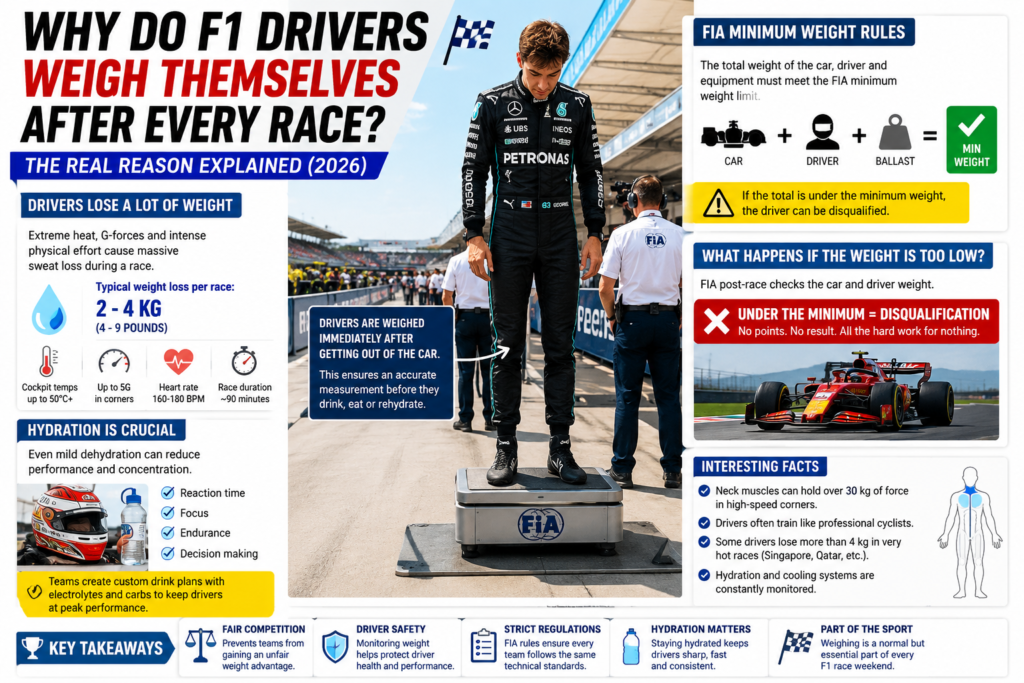
FIA Minimum Weight Regulations
The FIA sets a minimum weight requirement for every Formula 1 car and driver.
Unlike many other racing series, the driver’s body weight is considered part of the total package. Teams must ensure that the combined weight of the car, driver, ballast, and equipment meets the minimum limit established in the technical regulations.
If the combined weight falls below the legal minimum after a race, the driver can be disqualified regardless of where they finished.
This rule prevents teams from gaining an unfair performance advantage by making the car excessively light.
Drivers Lose a Surprising Amount of Weight
Formula 1 is one of the most physically demanding sports in the world.
During a typical Grand Prix, drivers experience:
- Cockpit temperatures exceeding 50°C (122°F)
- Up to 5G during heavy braking and cornering
- Heart rates averaging 160–180 beats per minute
- Around 90 minutes of intense physical effort
Because of these extreme conditions, drivers commonly lose between 2 and 4 kilograms (4–9 pounds) through sweat during a single race.
On particularly hot race weekends, the weight loss can be even greater.
Why Does Hydration Matter?
Losing several kilograms of body fluid isn’t just uncomfortable—it directly affects performance.
Even mild dehydration can reduce:
- Reaction time
- Concentration
- Muscle endurance
- Decision-making ability
Formula 1 drivers therefore spend days preparing with hydration strategies before every race weekend.
Many teams also design personalized drinks containing electrolytes and carbohydrates to help drivers maintain peak performance throughout the race.
Why Drivers Are Weighed Immediately
The FIA requires drivers to report directly to the weighing scales after leaving the car.
This immediate measurement provides officials with an accurate post-race weight before the driver has time to eat, drink, or recover significant fluids.
The process ensures consistent and fair measurements for every competitor.
Can Drivers Be Disqualified?
Yes.
If post-race scrutineering finds that the car and driver combination is under the legal minimum weight, the result may be invalidated.
However, officials understand that drivers naturally lose weight through sweating during competition.
The regulations include procedures to account for normal fluid loss while still ensuring teams comply with the technical rules.
Interesting Facts About Driver Weight
Some fascinating facts include:
- Drivers often train like professional cyclists rather than traditional athletes.
- Neck muscles can support forces exceeding 30 kilograms during high-speed cornering.
- Some drivers lose more than 4 kilograms in extremely hot races such as Singapore or Qatar.
- Teams continuously monitor hydration before, during, and after every race.
Frequently Asked Questions
Why are Formula 1 drivers weighed after qualifying?
Drivers may also be weighed after qualifying sessions to ensure compliance with FIA technical regulations.
Do all drivers lose weight during a race?
Yes. Every driver loses body fluids through sweat, although the exact amount varies depending on temperature, race length, and individual physiology.
Does a lighter driver have an advantage?
Modern FIA regulations minimize any potential advantage by including driver weight within the overall minimum weight calculation.
Final Thoughts
Weighing Formula 1 drivers after every race is about much more than tracking fitness.
It ensures fairness, supports safety regulations, and guarantees that every team competes within the FIA’s strict technical rules.
The next time you watch a Grand Prix, you’ll know that the quick trip to the scales is one of the most important parts of the post-race inspection process.