
What Do Formula 1 Flags Mean? Complete Guide to Every F1 Flag (2026)
What Do Formula 1 Flags Mean? Complete Guide to Every F1 Flag (2026)
Formula 1 is one of the fastest and most exciting sports in the world, but it also relies on a universal communication system to keep drivers, teams, and race officials safe.
That system is the flag system.
If you’re new to Formula 1, you may wonder why marshals wave different colored flags throughout a race. Each flag has a specific meaning, and every driver must respond immediately.
Here’s a complete guide to every Formula 1 flag used during the 2026 season.
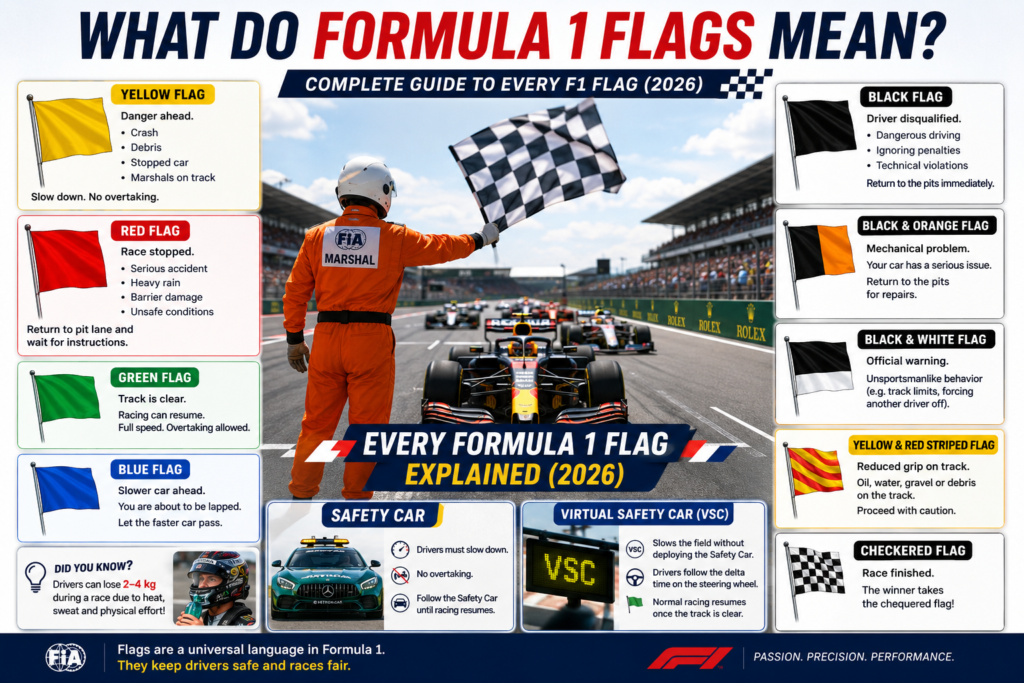
🟡 Yellow Flag
A yellow flag warns drivers of danger ahead.
This may include:
- A crashed car
- Debris on the track
- A stopped vehicle
- Marshals working near the circuit
Drivers must slow down and overtaking is prohibited.
Ignoring a yellow flag can result in severe penalties.
🔴 Red Flag
The red flag stops the race immediately.
Common reasons include:
- Major accidents
- Heavy rain
- Barrier damage
- Unsafe track conditions
When a red flag is shown, drivers return to the pit lane and wait for instructions from race control.
🟢 Green Flag
The green flag means the track is clear again.
Drivers may resume racing at full speed, and overtaking is allowed once more.
🔵 Blue Flag
The blue flag is shown to slower cars that are about to be lapped.
Drivers receiving a blue flag must allow the faster car to pass safely.
Ignoring repeated blue flags may lead to time penalties.
⚫ Black Flag
The black flag is one of the most serious flags in Formula 1.
It means the driver has been disqualified from the race.
Reasons may include:
- Dangerous driving
- Ignoring penalties
- Technical violations
The driver must return to the pits immediately.
⚫🟠 Black and Orange Flag
Known as the “Mechanical Flag.”
It tells a driver that their car has a dangerous mechanical problem.
The driver must return to the pits for repairs before continuing.
⚫⚪ Black and White Flag
This is an official warning.
It is usually issued for unsportsmanlike driving, such as repeatedly exceeding track limits or forcing another driver off the circuit.
A second offense could result in a penalty.
🟡🔴 Yellow and Red Striped Flag
This flag warns drivers about reduced grip.
Possible causes include:
- Oil
- Water
- Gravel
- Debris
Drivers should proceed with caution.
🏁 Checkered Flag
The most famous flag in motorsport.
The checkered flag signals that the race has finished.
Once every car crosses the finish line, the Grand Prix officially ends.
Safety Car Board
Although not technically a flag, the Safety Car signal is one of the most important race notifications.
When deployed:
- Drivers must slow down.
- Overtaking is prohibited.
- Cars line up behind the Safety Car until racing resumes.
Virtual Safety Car (VSC)
The Virtual Safety Car slows the field without deploying the actual Safety Car.
Drivers must follow a delta time displayed on their steering wheel.
Once the incident is cleared, normal racing resumes.
Frequently Asked Questions
What is the rarest F1 flag?
The black flag is one of the rarest because it means immediate disqualification.
Can drivers overtake under a yellow flag?
No.
Overtaking is prohibited while a yellow flag is displayed.
What flag ends an F1 race?
The checkered flag officially ends every Formula 1 race.
Final Thoughts
Formula 1 flags are essential for keeping races safe and fair.
Whether you’re watching your first Grand Prix or following the championship every weekend, understanding the flag system will help you enjoy every race even more.
The next time you see a marshal waving a flag, you’ll know exactly what it means.