
What Is DRS in F1? Complete Beginner Guide (2026)
What Is DRS in F1? Complete Beginner Guide (2026)
If you’re new to Formula 1, you’ve probably heard commentators say,
“DRS is now enabled.”
Moments later, one driver suddenly overtakes another on the straight.
But what exactly is DRS, and why does it make such a huge difference?
In this guide, we’ll explain what DRS is, how it works, when drivers can use it, and why it has become one of the most important overtaking tools in modern Formula 1.
What Does DRS Stand For?
DRS stands for Drag Reduction System.
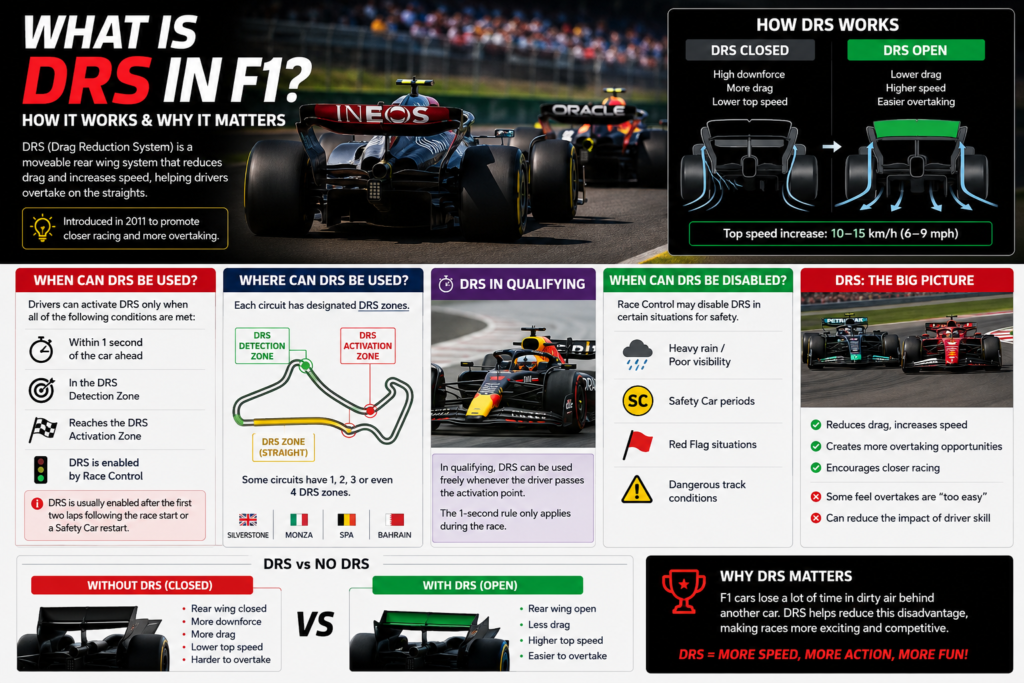
It is a movable rear wing system that reduces aerodynamic drag, allowing a Formula 1 car to achieve a significantly higher top speed on designated sections of the track.
The system was introduced by the FIA in 2011 to encourage more overtaking during races.
How Does DRS Work?
Normally, the rear wing creates downforce, helping the car maintain grip through corners.
However, more downforce also creates more aerodynamic drag, reducing straight-line speed.
When DRS is activated:
✅ The upper flap of the rear wing opens.
✅ Air resistance decreases.
✅ The car accelerates faster.
✅ Top speed can increase by 10–15 km/h (6–9 mph) depending on the circuit.
This speed advantage often helps drivers complete overtaking maneuvers before the next braking zone.
When Can Drivers Use DRS?
Drivers cannot use DRS whenever they want.
There are strict FIA rules.
A driver may activate DRS only when:
- They are within 1 second of the car ahead.
- They are inside an official DRS Detection Zone.
- They reach the designated DRS Activation Zone.
- Race Control has enabled DRS.
DRS is usually enabled after the first two racing laps following the race start or a Safety Car restart.
Where Can DRS Be Used?
Every Formula 1 circuit has specific DRS zones.
Some tracks have:
- One DRS Zone
- Two DRS Zones
- Three DRS Zones
- Occasionally even four zones on selected circuits
Famous examples include:
- Silverstone
- Monza
- Spa-Francorchamps
- Bahrain
Each circuit is designed differently depending on overtaking opportunities.
Can Drivers Use DRS in Qualifying?
Yes.
During qualifying sessions, drivers may use DRS freely whenever they pass an activation point.
The 1-second rule only applies during the race.
This allows drivers to maximize speed while setting their fastest lap.
Can DRS Be Disabled?
Absolutely.
Race Control may disable DRS when:
- Heavy rain
- Poor visibility
- Safety Car periods
- Red Flag situations
- Dangerous track conditions
Safety always comes before performance.
Why Is DRS Controversial?
Some fans love DRS because it creates exciting overtaking.
Others believe it makes passing too easy.
Supporters argue that:
- It improves racing.
- Cars can follow each other more closely.
- More overtakes create better entertainment.
Critics argue:
- It gives an artificial speed advantage.
- Some overtakes become too easy.
- Driver skill becomes less important.
Despite the debate, DRS remains one of the defining features of modern Formula 1.
DRS vs No DRS
| Without DRS | With DRS |
|---|---|
| Rear wing closed | Rear wing open |
| More downforce | Less drag |
| Better cornering grip | Higher straight-line speed |
| Lower top speed | Higher top speed |
| Harder to overtake | Easier overtaking |
Why Is DRS Important?
Formula 1 cars produce enormous aerodynamic turbulence.
Without DRS, following another car closely can be extremely difficult.
DRS helps reduce this disadvantage, allowing more competitive racing and increasing overtaking opportunities throughout the season.
Final Thoughts
DRS has transformed Formula 1 by making races more exciting and encouraging overtaking.
Although opinions remain divided, understanding how DRS works is essential for anyone who wants to enjoy modern Formula 1.
The next time you hear,
“DRS Enabled.”
you’ll know exactly why the battle is about to become much more exciting.
Conclusion
DRS is much more than a button drivers press on the steering wheel.
It is a carefully regulated system designed to balance speed, strategy, and overtaking.
Whether you’re watching your first Grand Prix or becoming a dedicated Formula 1 fan, understanding DRS will make every race easier to follow.