
Bakuchiol vs Retinol, Sensitive Skin?
Bakuchiol vs Retinol: Which Is Better for Sensitive Skin?
Retinol has long been considered one of the gold standards for reducing the appearance of fine lines and improving skin texture. But for many people, the benefits come with a downside—dryness, redness, and irritation.
That’s where bakuchiol enters the conversation.
Often described as a plant-based alternative to retinol, bakuchiol has become increasingly popular among people with sensitive skin. But are the two ingredients really interchangeable?
Let’s compare how they work, their benefits, and which one may be the better choice for your skincare routine.
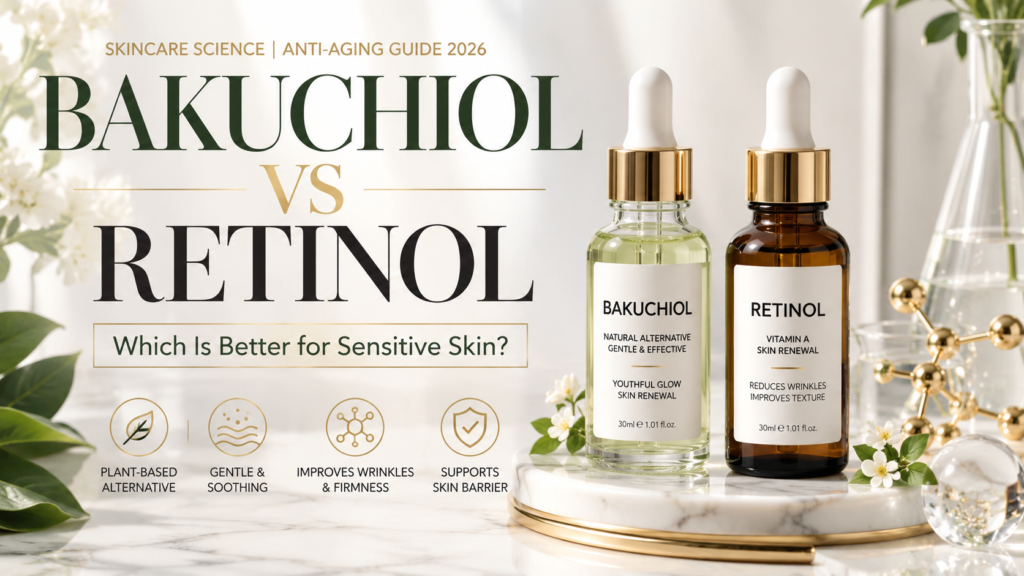
What Is Bakuchiol?
Bakuchiol is a naturally derived compound extracted from the seeds and leaves of the Psoralea corylifolia plant (also known as babchi).
Although it isn’t a form of vitamin A, research suggests that bakuchiol can help improve the appearance of fine lines, skin firmness, and uneven texture while causing less irritation than retinol.
What Is Retinol?
Retinol is a vitamin A derivative that accelerates skin cell turnover.
It has decades of research supporting its effectiveness in improving:
- Fine lines
- Wrinkles
- Uneven skin tone
- Acne
- Skin texture
However, retinol commonly causes temporary dryness and irritation, especially during the first several weeks of use.
Bakuchiol vs Retinol
| Feature | Bakuchiol | Retinol |
|---|---|---|
| Best For | Sensitive skin | Moderate to advanced anti-aging |
| Irritation | Very low | Moderate |
| Pregnancy | Consult a healthcare professional before use | Generally avoided during pregnancy |
| Sun Sensitivity | Minimal | Increased |
| Daily Use | Morning & night | Usually nighttime only |
| Skin Barrier | Gentle support | May temporarily weaken |
Which Ingredient Is Better?
Choose Bakuchiol if you:
- Have sensitive or easily irritated skin
- Are new to anti-aging skincare
- Want a gentle daily routine
- Prefer plant-derived skincare ingredients
Choose Retinol if you:
- Want stronger wrinkle-reducing effects
- Have previous experience with active ingredients
- Can tolerate temporary dryness
- Always wear sunscreen during the day
Can You Use Them Together?
Some skincare routines combine bakuchiol and retinol to balance effectiveness with comfort.
Because formulations vary, introduce new active ingredients gradually and pay attention to how your skin responds. If irritation develops, reduce frequency or consult a dermatologist.
Common Mistakes
Expecting instant results
Neither ingredient delivers overnight changes. Visible improvements often require several weeks of consistent use.
Ignoring moisturizer
Hydrated skin is better able to tolerate active ingredients.
Forgetting sunscreen
If you use retinol, broad-spectrum sunscreen every morning is an essential part of your routine.
Related Reading
If you’re also comparing other anti-aging ingredients, don’t miss our guide:
Peptide vs Retinol: Which Anti-Aging Ingredient Is Better?
Final Thoughts
Bakuchiol and retinol both have a place in modern skincare, but they serve different needs.
If your priority is maximum wrinkle reduction and you can tolerate stronger active ingredients, retinol remains one of the most studied options.
If your skin is sensitive or you’re looking for a gentler introduction to anti-aging skincare, bakuchiol offers an appealing alternative that many people find easier to use consistently.
The best ingredient is ultimately the one that fits your skin, your routine, and your long-term skincare goals.
Key Takeaways
- Bakuchiol is a plant-derived ingredient commonly used as a gentler alternative to retinol.
- Retinol has stronger evidence for improving visible signs of aging but may cause irritation.
- Sensitive skin often tolerates bakuchiol better.
- Moisturizer and sunscreen are important companions to any anti-aging routine.
- Consistency matters more than choosing the strongest product.
FAQ
Is bakuchiol as effective as retinol?
Bakuchiol has shown promising anti-aging effects in some studies, but retinol has a much larger body of long-term clinical evidence.
Can I use bakuchiol every day?
Many people can use bakuchiol once or twice daily, depending on the product instructions and individual skin tolerance.
Is bakuchiol safe for sensitive skin?
It is generally considered gentler than retinol, though any new skincare product can still cause irritation in some individuals.
Should I stop using retinol?
Not necessarily. If retinol works well for your skin, there is usually no reason to stop. If irritation becomes a problem, bakuchiol may be worth discussing with a skincare professional.
Which is better for beginners?
People with sensitive skin often find bakuchiol easier to start with, while others may choose a low-strength retinol and introduce it gradually.