
10 Major U.S. Economic Events That Could Move the Stock Market in August 2026
10 Major U.S. Economic Events That Could Move the Stock Market in August 2026
August has historically been one of the most closely watched months for investors.
Several important economic reports, Federal Reserve events, and corporate earnings announcements can significantly influence stock prices, bond yields, and the U.S. dollar.
Here are the biggest events investors should monitor.
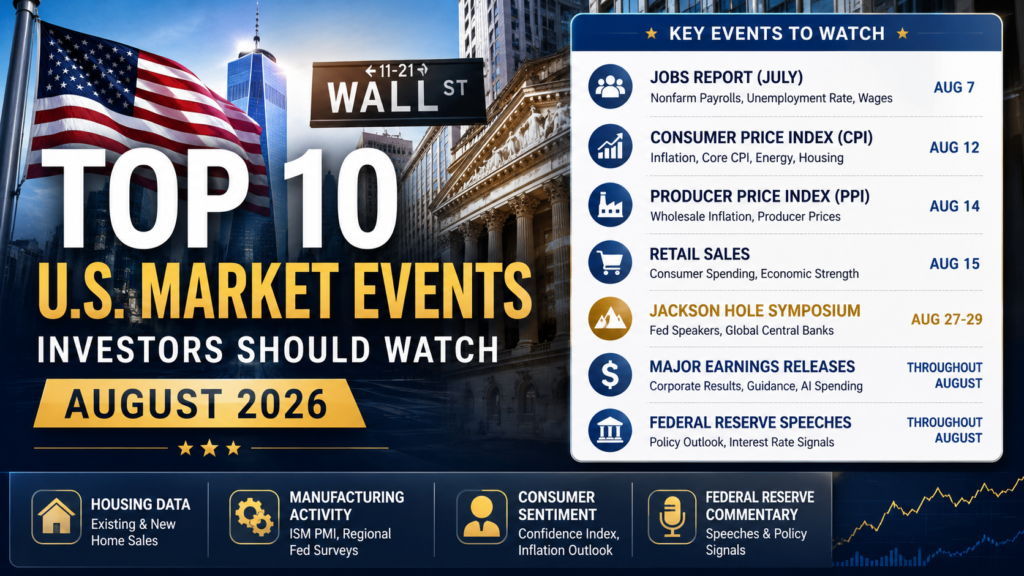
1. July Employment Report (Nonfarm Payrolls)
The monthly jobs report remains one of the most influential market-moving events.
Investors will closely examine:
- Job creation
- Unemployment rate
- Wage growth
A stronger-than-expected report could reinforce expectations for tighter monetary policy, while weaker employment data may increase hopes for interest-rate cuts later in the year.
2. Consumer Price Index (CPI)
Inflation remains one of the Federal Reserve’s primary concerns.
The CPI report provides insight into:
- Consumer inflation
- Core inflation
- Housing costs
- Energy prices
Markets often experience increased volatility immediately after the CPI release.
3. Producer Price Index (PPI)
PPI measures inflation at the wholesale level.
Because businesses frequently pass higher costs on to consumers, investors watch this report as an early indicator of future CPI trends.
4. Retail Sales
Consumer spending represents nearly 70% of the U.S. economy.
A strong Retail Sales report usually supports sectors such as:
- Consumer discretionary
- Financials
- Travel
- Retail
Weak spending may raise concerns about slowing economic growth.
5. Jackson Hole Economic Symposium
One of the most anticipated events of the year is the Federal Reserve Bank of Kansas City’s annual Jackson Hole Symposium, scheduled for August 27–29, 2026.
Central bankers and economists from around the world gather to discuss monetary policy and the future of the global economy.
Investors pay particularly close attention to any policy signals from Federal Reserve officials.
6. Corporate Earnings
Although the busiest earnings season occurs in July, several influential companies continue reporting results throughout August.
Investors will focus on:
- Revenue growth
- AI investment
- Profit margins
- Forward guidance
Management commentary often has a larger market impact than headline earnings.
7. Housing Market Data
Housing reports such as:
- Existing Home Sales
- New Home Sales
help investors evaluate the strength of the U.S. consumer and the broader economy.
8. Manufacturing Activity
Manufacturing surveys provide early clues about economic momentum.
Particular attention is paid to:
- ISM Manufacturing PMI
- Regional Fed surveys
These indicators often influence industrial and cyclical stocks.
9. Consumer Sentiment
Consumer confidence affects future spending.
The University of Michigan Consumer Sentiment Index remains one of the most closely watched indicators for household expectations and inflation outlook.
10. Federal Reserve Commentary
Even without an official FOMC meeting, speeches from Federal Reserve officials throughout August can significantly move financial markets.
Investors carefully analyze every public comment for clues about future interest-rate policy.
Why August Matters
August often combines lower trading volume with several major economic releases.
This combination can lead to larger-than-normal market swings, making risk management especially important for investors.
Keeping track of these events can help investors better understand short-term market movements while maintaining a long-term investment perspective.
Key Takeaways
- Employment data remains one of the biggest market catalysts.
- CPI and PPI reports provide critical inflation signals.
- Retail Sales reveal the strength of U.S. consumers.
- Jackson Hole is one of the year’s most important Federal Reserve events.
- Corporate earnings guidance can influence entire sectors.