
What Is F1 Sprint? Complete Guide to F1 Sprint Rules in 2026
What Is F1 Sprint? Complete Guide to F1 Sprint Rules in 2026
If you’re new to Formula 1, you’ve probably heard the term “F1 Sprint” and wondered what it actually means.
Is it the main race?
Does the Sprint decide the Grand Prix winner?
Why was it introduced?
In this guide, we’ll explain what an F1 Sprint is, how it works, the 2026 Sprint rules, and how it’s different from a traditional Grand Prix race.
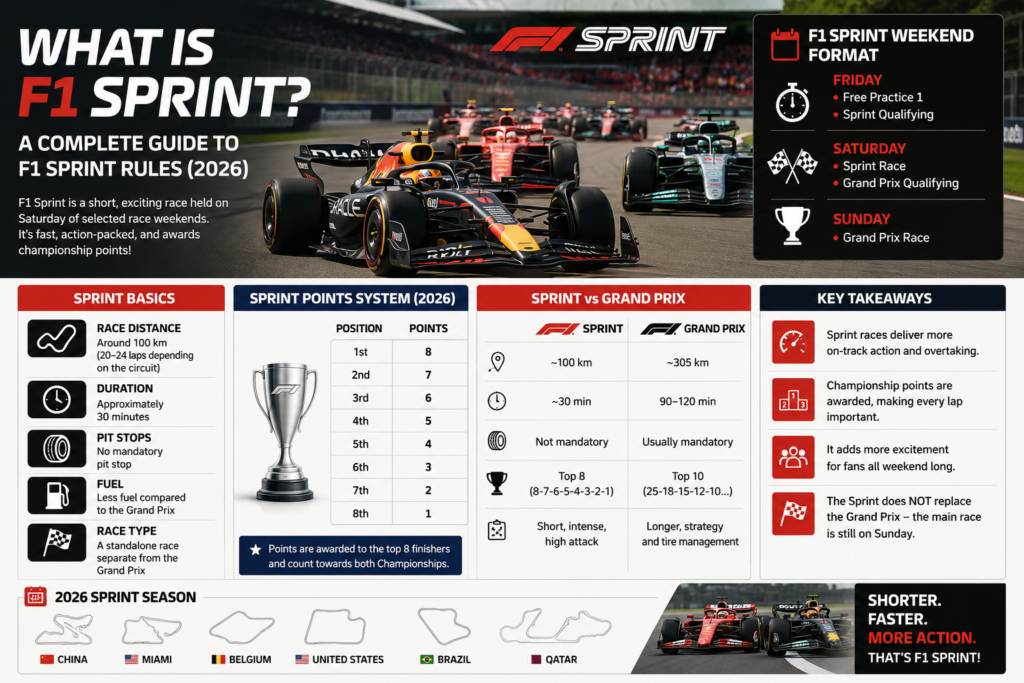
What Is an F1 Sprint?
An F1 Sprint is a short race held during selected Formula 1 weekends.
Unlike the Grand Prix, the Sprint is designed to deliver fast-paced racing with more overtaking and excitement.
It is a standalone race that awards championship points but does not replace Sunday’s Grand Prix.
How Does an F1 Sprint Weekend Work?
During a Sprint weekend, the schedule looks like this:
Friday
- Free Practice 1
- Sprint Qualifying
Saturday
- Sprint Race
- Grand Prix Qualifying
Sunday
- Grand Prix Race
This format gives fans competitive action on every day of the race weekend.
F1 Sprint Rules (2026)
Sprint Distance
The Sprint covers approximately 100 km, which usually equals 20–24 laps depending on the circuit.
The race lasts around 30 minutes.
No Mandatory Pit Stop
Unlike the Grand Prix, drivers are not required to make a pit stop during the Sprint.
Teams can complete the race using one set of tires if conditions allow.
Sprint Championship Points
The top eight drivers score points.
| Position | Points |
|---|---|
| 1st | 8 |
| 2nd | 7 |
| 3rd | 6 |
| 4th | 5 |
| 5th | 4 |
| 6th | 3 |
| 7th | 2 |
| 8th | 1 |
These points count toward both the Drivers’ Championship and the Constructors’ Championship.
Sprint vs Grand Prix
| Sprint Race | Grand Prix |
|---|---|
| Around 100 km | Around 305 km |
| 30 minutes | 90–120 minutes |
| No mandatory pit stop | Mandatory tire strategy |
| Top 8 score points | Top 10 score points |
| Short, aggressive racing | Full race strategy |
Why Was the Sprint Introduced?
Formula 1 introduced Sprint races to make race weekends more exciting.
Instead of having only qualifying on Saturday, fans now enjoy an additional competitive race with championship points on the line.
Sprint weekends also increase opportunities for:
- Overtaking
- Different race strategies
- Championship battles
- Unpredictable results
Are Sprint Races More Dangerous?
Sprint races are often more aggressive than the Grand Prix.
Since the race is much shorter, drivers push harder from the very first lap, leading to more overtaking attempts and sometimes more incidents.
The opening corners are usually among the most exciting moments of the entire weekend.
Which Drivers Benefit Most?
Sprint races generally favor drivers who:
- Make excellent race starts
- Are confident in wheel-to-wheel battles
- Can manage tires over short distances
- Adapt quickly to changing conditions
These skills often make the difference in a 30-minute race.
Is the Sprint Worth Watching?
Absolutely.
For new Formula 1 fans, the Sprint is one of the easiest ways to enjoy the sport.
The races are short, action-packed, and every point matters in the championship.
Many fans consider Sprint weekends to be among the most entertaining events of the season.
Final Thoughts
The F1 Sprint has become an important part of modern Formula 1.
Although it’s much shorter than the Grand Prix, it still offers championship points, exciting overtakes, and intense racing from start to finish.
If you’re just getting into Formula 1, understanding the Sprint format will make every race weekend much more enjoyable.