
What Is DRS in Formula 1? Complete Beginner’s Guide (2026)
What Is DRS in Formula 1? Complete Beginner’s Guide (2026)
If you’ve ever watched a Formula 1 race, you’ve probably heard commentators mention DRS during overtaking battles.
But what exactly is DRS, and why is it so important?
Here’s everything you need to know about Formula 1’s Drag Reduction System in 2026.
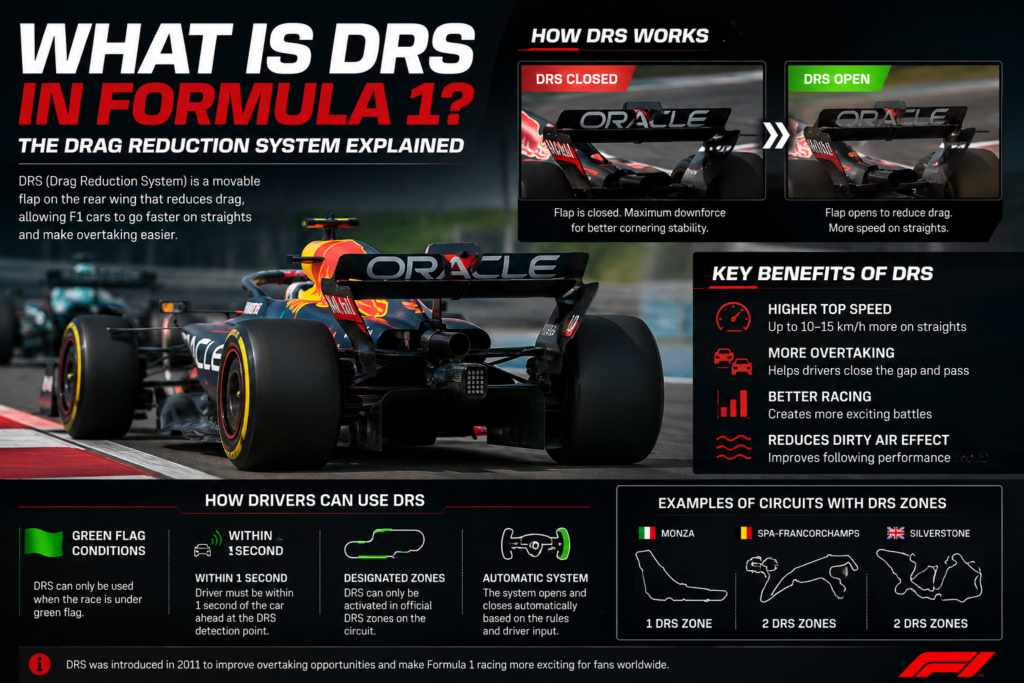
What Does DRS Stand For?
DRS stands for Drag Reduction System.
It is a movable flap on the rear wing of an F1 car that reduces aerodynamic drag, allowing the car to reach a higher top speed on designated sections of the circuit.
The system was introduced by the FIA in 2011 to encourage more overtaking.
How Does DRS Work?
Normally, the rear wing creates downforce that helps cars corner at high speed.
When DRS is activated:
- The rear wing flap opens.
- Air resistance (drag) decreases.
- The car accelerates faster.
- Top speed can increase by 10–15 km/h depending on the circuit.
Once the driver brakes for the next corner, the wing automatically closes.
When Can Drivers Use DRS?
Drivers cannot use DRS whenever they want.
There are strict FIA rules:
- The race must be under green-flag conditions.
- The driver must be within one second of the car ahead at the official DRS detection point.
- DRS can only be used in designated activation zones.
During qualifying and practice, DRS may generally be used more freely when conditions allow.
Why Was DRS Introduced?
Modern Formula 1 cars generate enormous aerodynamic turbulence.
This “dirty air” makes it difficult for a following driver to stay close enough to attempt an overtake.
DRS helps reduce that disadvantage by giving the chasing driver a temporary speed boost.
Does Every Circuit Have DRS Zones?
Yes, but the number varies.
Most Formula 1 circuits have:
- One DRS zone
- Two DRS zones
- Three DRS zones (at selected tracks)
Examples:
- Monza – Long straights with powerful DRS effect.
- Spa-Francorchamps – Famous Kemmel Straight DRS zone.
- Silverstone – Multiple overtaking opportunities.
The FIA reviews DRS zones before every Grand Prix.
Advantages of DRS
✅ More overtaking
✅ More exciting races
✅ Better wheel-to-wheel battles
✅ Reduced impact of dirty air
Criticism of DRS
Some fans believe DRS makes overtaking too easy.
Others argue it remains necessary because today’s Formula 1 cars still create significant aerodynamic turbulence.
The FIA continues to evaluate how DRS should evolve alongside future technical regulations.
Will DRS Stay in Formula 1?
As Formula 1 continues developing new aerodynamic rules, the future of DRS is regularly discussed.
Even so, DRS remains an important feature of the 2026 season, helping create close racing and strategic overtaking.
Final Thoughts
DRS is one of the most recognizable technologies in modern Formula 1.
Understanding how it works makes every overtake far more exciting to watch.
Whether you’re a new fan or a longtime supporter, knowing the role of DRS will help you appreciate the strategy and engineering behind every Grand Prix.