
How AI Data Centers Really Work
How AI Data Centers Really Work: Chips, Optical Networks & Power Explained
When people talk about artificial intelligence, the conversation often focuses on GPUs or semiconductor companies. While those chips are incredibly important, they represent only one part of a much larger ecosystem.
Every AI model—from chatbots to image generators—depends on a complex infrastructure where semiconductors, optical communication, electricity, cooling systems, and cloud software work together. If any one of these components becomes a bottleneck, overall AI performance can suffer.
Here’s how a modern AI data center actually works.
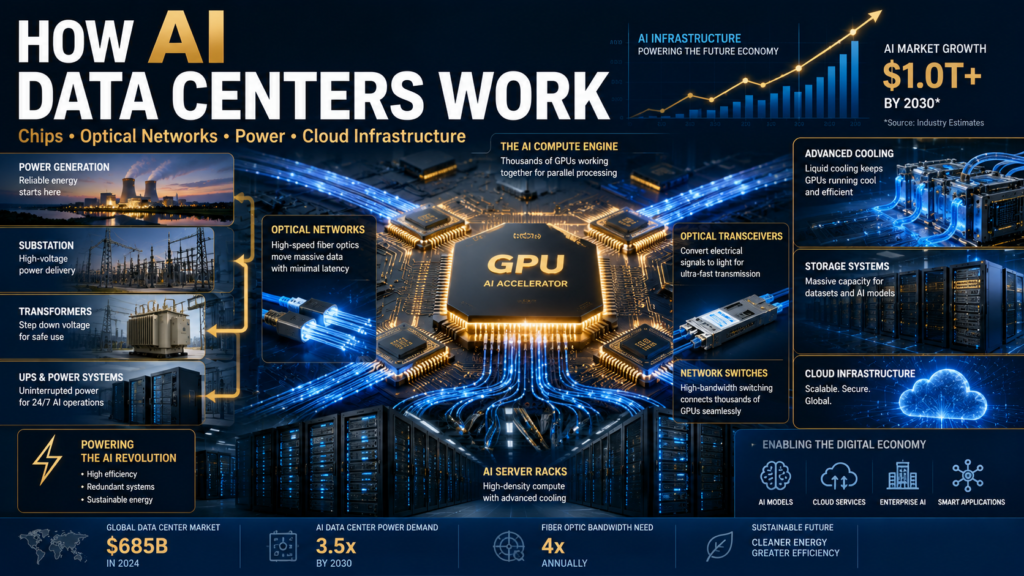
Step 1: Electricity Is the Starting Point
Every AI calculation begins with electricity.
Unlike traditional office servers, AI servers equipped with multiple high-performance GPUs consume enormous amounts of power. A single rack can require far more electricity than older enterprise systems, making reliable power infrastructure one of the biggest challenges for modern AI facilities.
The process typically begins with:
- High-voltage utility power
- Substations
- Transformers
- Backup generators
- UPS (Uninterruptible Power Supply)
- Power distribution units
Only after electricity is stabilized and distributed can computing begin.
Step 2: GPUs Become the AI Brain
Once power reaches the servers, GPUs perform the massive parallel calculations required for AI training and inference.
Unlike CPUs, which excel at sequential processing, GPUs are designed to execute thousands of mathematical operations simultaneously.
These processors handle tasks such as:
- Training large language models
- Image generation
- Video processing
- Scientific simulations
- Recommendation systems
However, a GPU cannot work efficiently in isolation.
Step 3: Optical Networks Connect Thousands of GPUs
Modern AI clusters often contain thousands—or even tens of thousands—of GPUs working together.
Copper cables quickly become a limitation over longer distances because of bandwidth and signal loss.
Instead, AI data centers increasingly rely on fiber-optic communication.
High-speed optical transceivers convert electrical signals into light, allowing enormous amounts of data to travel between servers with minimal latency.
This is why optical networking companies have become increasingly important to AI infrastructure.
Step 4: High-Speed Switching Keeps Data Moving
Between every GPU sits another critical layer:
The network switch.
High-performance Ethernet and InfiniBand switches direct data traffic between servers, storage systems, and AI clusters.
Without efficient switching, GPUs spend valuable time waiting for data instead of performing calculations.
For AI workloads, network performance has become almost as important as computing power itself.
Step 5: Storage Feeds the AI Models
AI models require massive datasets.
Training may involve petabytes of text, images, code, or video.
Storage systems continuously deliver this information to GPU clusters while also saving intermediate checkpoints and trained models.
Fast SSD arrays and distributed storage architectures help prevent data bottlenecks.
Step 6: Cooling Protects Performance
Powerful GPUs generate significant heat.
If temperatures rise too high, processors automatically reduce performance to prevent damage.
To maintain stable operation, modern AI data centers increasingly use:
- Advanced air cooling
- Liquid cooling
- Rear-door heat exchangers
- Direct-to-chip cooling
- Immersion cooling (in selected facilities)
Cooling has become one of the fastest-growing areas of AI infrastructure investment.
How Everything Works Together
A simplified AI infrastructure looks like this:
Power Grid
      │
Substation
      │
Transformers
      │
UPS & Backup Systems
      │
GPU Servers
      │
Optical Fiber
      │
High-Speed Switches
      │
Storage Systems
      │
Cloud Platform
      │
AI Applications
Every layer depends on the one before it.
A shortage of electricity, networking equipment, or cooling capacity can reduce the performance of the entire system.
Why Investors Are Watching the Entire Supply Chain
One of the biggest investment themes in 2026 is that AI infrastructure extends well beyond semiconductor manufacturers.
Growing AI demand has increased attention on companies involved in:
| Infrastructure Layer | Examples |
|---|---|
| Semiconductor Chips | GPU and AI accelerator manufacturers |
| Memory | High-bandwidth memory suppliers |
| Optical Networking | Fiber optics, optical transceivers, photonics |
| Networking | High-speed Ethernet and InfiniBand equipment |
| Power Infrastructure | Transformers, UPS systems, electrical equipment |
| Cooling | Liquid cooling, HVAC, thermal management |
| Cloud Infrastructure | Data center operators and hyperscalers |
Rather than relying on a single technology, modern AI depends on an entire ecosystem working together.
Final Thoughts
The next wave of artificial intelligence will not be driven by chips alone.
Semiconductors provide the computing power, but optical communication keeps data moving, electrical infrastructure keeps systems running, storage delivers information, and cooling protects performance.
Understanding how these components interact helps explain why investors, governments, and technology companies continue investing billions of dollars across the entire AI infrastructure supply chain—not just in GPUs.
Key Takeaways
- AI data centers require reliable power before computing can begin.
- GPUs perform AI calculations but depend on high-speed networking.
- Optical fiber enables thousands of GPUs to communicate with low latency.
- Cooling systems are essential for maintaining performance.
- The AI investment opportunity spans chips, networking, power, cooling, storage, and cloud infrastructure.
FAQ
Why do AI data centers use GPUs instead of CPUs?
GPUs are optimized for parallel processing, making them much faster for training and running AI models.
Why is optical networking important?
Fiber-optic connections can transfer large volumes of data at very high speeds with lower latency over longer distances than traditional copper cables.
Why do AI data centers consume so much electricity?
Training and serving advanced AI models require thousands of high-performance processors operating simultaneously, which significantly increases power demand.
What is the biggest bottleneck in AI infrastructure?
It depends on the deployment, but power availability, networking bandwidth, cooling capacity, and advanced semiconductor supply are all common constraints.