
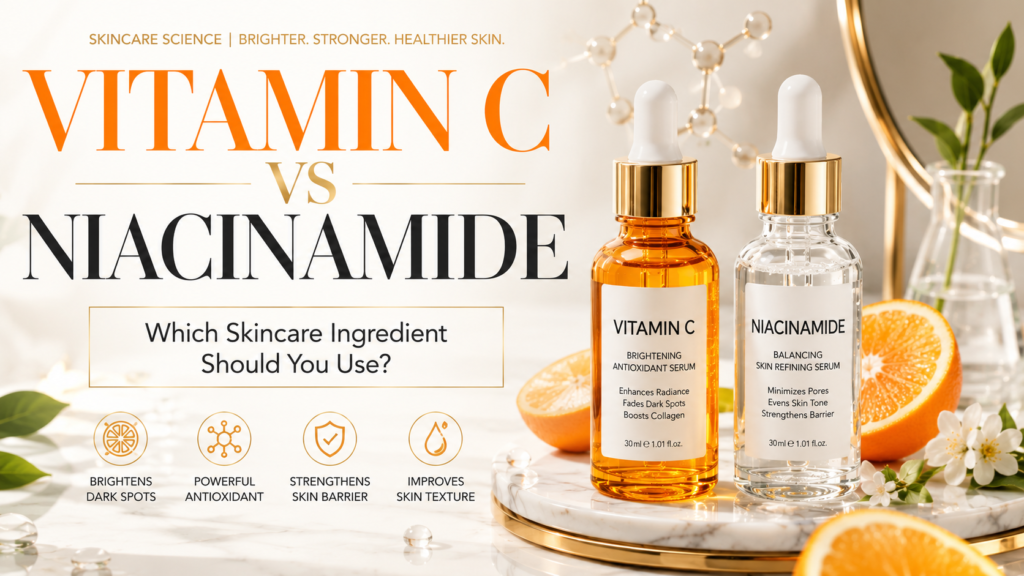
Vitamin C vs Niacinamide: Which Skincare
Vitamin C vs Niacinamide: Which Skincare Ingredient Should You Use?
Walk into almost any skincare aisle, and you’ll quickly notice two ingredients appearing again and again: vitamin C and niacinamide.
Both are popular for improving the appearance of skin, but they aren’t designed to do exactly the same job. One is known for brightening and antioxidant protection, while the other focuses on strengthening the skin barrier and balancing oil production.
Understanding the difference can help you choose the right product—or even use both effectively.
What Is Vitamin C?
Vitamin C is a powerful antioxidant that helps protect the skin from environmental stress caused by pollution and UV exposure.
It is widely used to improve the appearance of:
- Dull skin
- Uneven skin tone
- Dark spots
- Hyperpigmentation
- Early signs of aging
Because it helps support collagen production, vitamin C is also a common ingredient in anti-aging routines.
What Is Niacinamide?
Niacinamide is a form of vitamin B3 that helps strengthen the skin barrier while improving overall skin balance.
It is commonly used to reduce the appearance of:
- Enlarged pores
- Excess oil
- Redness
- Uneven skin tone
- Dryness caused by a weakened skin barrier
Unlike stronger active ingredients, niacinamide is generally well tolerated by most skin types.
Vitamin C vs Niacinamide
| Feature | Vitamin C | Niacinamide |
|---|---|---|
| Main Benefit | Brightening | Barrier Support |
| Best For | Dark spots | Sensitive skin |
| Antioxidant | Excellent | Moderate |
| Oil Control | Limited | Excellent |
| Irritation Risk | Moderate | Low |
| Daily Use | Morning or evening | Morning & evening |
Which Ingredient Should You Choose?
Choose Vitamin C if you:
- Want brighter-looking skin
- Have dark spots or post-acne marks
- Spend time outdoors
- Want antioxidant protection
Choose Niacinamide if you:
- Have oily skin
- Experience redness
- Want to improve the skin barrier
- Have enlarged pores
Can You Use Them Together?
Yes.
Older skincare advice suggested avoiding this combination, but modern formulations and research indicate that vitamin C and niacinamide can generally be used together in the same routine.
Many skincare brands now include both ingredients in complementary routines.
One simple approach is:
Morning
- Gentle cleanser
- Vitamin C serum
- Moisturizer
- Sunscreen SPF 30 or higher
Evening
- Cleanser
- Niacinamide serum
- Moisturizer
Common Mistakes
Using too many active ingredients at once
Introducing several new products together can make it difficult to identify which one is causing irritation.
Forgetting sunscreen
Vitamin C supports sun protection, but it does not replace sunscreen.
Expecting immediate results
Most brightening products require consistent use for several weeks before visible improvements appear.
Related Reading
If you’re building an anti-aging skincare routine, you may also enjoy:
- Peptide vs Retinol: Which Anti-Aging Ingredient Is Better?
- Bakuchiol vs Retinol: Which Is Better for Sensitive Skin?
Final Thoughts
Vitamin C and niacinamide each offer unique benefits, and they don’t need to compete.
Vitamin C is an excellent choice if your goal is brighter, more even-looking skin and antioxidant protection.
Niacinamide shines when your focus is improving the skin barrier, reducing oiliness, and calming visible redness.
For many people, using both ingredients consistently is an effective way to build a balanced skincare routine.
Key Takeaways
- Vitamin C helps brighten skin and reduce the appearance of dark spots.
- Niacinamide strengthens the skin barrier and helps balance oil production.
- Both ingredients can often be used together.
- Daily sunscreen remains essential for healthy skin.
- Consistency is more important than using many products at once.
FAQ
Is vitamin C better than niacinamide?
Not necessarily. Vitamin C is often chosen for brightening and antioxidant protection, while niacinamide is popular for improving the skin barrier and reducing excess oil.
Can I use vitamin C and niacinamide together?
Yes. Most modern skincare routines can safely combine both ingredients.
Which ingredient is better for acne marks?
Vitamin C is commonly used to improve the appearance of post-inflammatory dark spots, while niacinamide may help reduce redness and support skin recovery.
Is niacinamide suitable for sensitive skin?
It is generally well tolerated, although individual reactions can vary.
Should I use vitamin C in the morning?
Many people apply vitamin C in the morning because of its antioxidant properties, followed by sunscreen.