
How AI Is Reshaping the Global Economy
How AI Is Reshaping the Global Economy in 2026: Winners, Risks, and What Investors Should Know
Artificial intelligence is no longer just a technology trend—it has become a major driver of the global economy.
According to the International Monetary Fund (IMF), the world economy in 2026 is being shaped by two powerful forces. On one side are geopolitical tensions and higher energy costs, which continue to weigh on growth. On the other is a wave of AI-driven investment that is boosting demand for semiconductors, data centers, cloud infrastructure, and advanced computing. IMF
For investors, understanding this balance between risk and opportunity is becoming increasingly important.
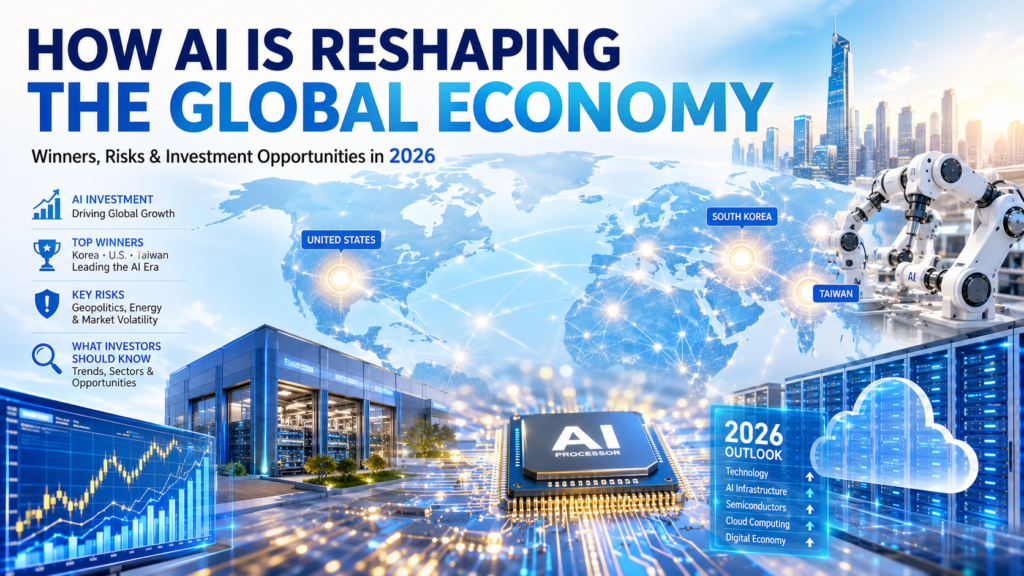
AI Is Becoming a Global Growth Engine
Massive investment in AI infrastructure has created strong demand across the technology supply chain.
Cloud providers are expanding data centers, semiconductor manufacturers are increasing production, and companies are investing heavily in AI software and hardware. These investments are supporting economic activity even as higher energy prices and geopolitical uncertainty remain challenges. IMF
Unlike previous technology cycles, AI spending is influencing multiple industries at once—from finance and healthcare to manufacturing and logistics.
Which Countries Are Benefiting the Most?
Not every economy is benefiting equally from the AI boom.
The IMF notes that countries deeply integrated into the AI hardware supply chain have outperformed many others. South Korea, Taiwan, Malaysia, and Thailand have seen stronger-than-expected growth thanks to robust exports of semiconductors and AI-related technology. IMF
South Korea, in particular, received an upgraded growth outlook as demand for AI hardware exports remained strong. IMF
AI Investment Also Brings New Risks
While AI is supporting economic growth, it is also creating new challenges.
The IMF warns that financial markets have become increasingly concentrated in AI-related companies. If investors begin to question whether AI investments will deliver the expected returns, markets could experience significant volatility. IMF
There are also broader concerns about how quickly productivity gains from AI will materialize. Some economists argue that widespread economic benefits may take longer than many investors currently expect. Financial Times
The Role of Data Centers and Semiconductor Companies
The AI boom is creating enormous demand for infrastructure.
Data centers require advanced processors, networking equipment, electricity, and cooling systems. As a result, companies involved in semiconductor manufacturing, AI chips, cloud computing, and digital infrastructure continue to attract significant investment. AP News
This trend has made AI infrastructure one of the most closely watched investment themes of 2026.
What Should Investors Watch?
Several factors could determine whether the AI-driven growth story continues.
- AI infrastructure spending
- Semiconductor demand
- Corporate earnings from major technology companies
- Global electricity and energy costs
- Central bank interest-rate decisions
- Geopolitical developments
If AI adoption continues to expand while inflation remains under control, technology-related sectors could continue to outperform. However, investors should also remain aware of valuation risks and changing market expectations. IMF
Final Thoughts
Artificial intelligence is reshaping the global economy in ways that extend far beyond the technology sector.
Countries leading the AI supply chain are seeing stronger growth, businesses are accelerating investment, and investors are increasingly viewing AI as a long-term structural trend rather than a short-term cycle.
At the same time, geopolitical uncertainty, higher energy costs, and elevated market expectations mean that the path forward is unlikely to be smooth.
For long-term investors, understanding both the opportunities and the risks of the AI economy will be essential in the years ahead.
Key Takeaways
- AI investment is becoming one of the biggest drivers of global economic growth.
- South Korea and other AI hardware exporters are benefiting from strong demand.
- Data centers and semiconductor companies remain key beneficiaries.
- High valuations and geopolitical risks could create market volatility.
- Long-term AI adoption may reshape multiple industries and investment opportunities.
FAQ
Why is AI important to the global economy in 2026?
AI investment is supporting economic growth through increased spending on semiconductors, data centers, cloud infrastructure, and enterprise software, helping offset some geopolitical and energy-related headwinds. IMF
Which countries are benefiting the most from the AI boom?
Countries with strong AI hardware and semiconductor industries—such as South Korea, Taiwan, Malaysia, and Thailand—have seen stronger-than-expected economic performance. IMF
What are the biggest risks?
Potential risks include overly optimistic market expectations, expensive AI-related stock valuations, geopolitical tensions, and uncertainty about how quickly AI will translate into broad productivity gains.